"Counterculture, Beats, Drugs, Underground, Punk"

Criteria:
  • Category = "Counterculture, Beats, Drugs, Underground, Punk"
  • SATSANG WITH SWAMIJI Woodstock Guru's Scarce Typescript From Early Integral Yoga Retreat by Sri Swami Satchidananda SATSANG WITH SWAMIJI Woodstock Guru's Scarce Typescript From Early Integral Yoga Retreat
    Sri Swami Satchidananda

    TEN DAY YOGA RETREAT With Sri Swami Satchidananda SATSANG WITH SWAMIJI Newport Rhode Island June 14-23, 1974

    Original typescript transcript comprehensively documenting Sri Swami Satchidananda's spiritual philosophy of peace, truth, and non-violence through his spoken words at one of his early archetypal yoga retreats. Beginning with his Friday June 14 Orientation Talk [spiritual purpose] followed by seven nights of his evening Satsang [spiritual discourse] lectures delivered to Retreatants on June 15 through June 22 (he took the night of June 21 off) at his Integral Yoga Retreat in Newport, Rhode Island, in 1974. Transcribed by his disciples this transcript preserves his spoken words, complete with his characteristic humor, metaphors, and direct interactions with students. A total of eight lectures. Xerography,…

    (more)

    TEN DAY YOGA RETREAT With Sri Swami Satchidananda SATSANG WITH SWAMIJI Newport Rhode Island June 14-23, 1974

    Original typescript transcript comprehensively documenting Sri Swami Satchidananda's spiritual philosophy of peace, truth, and non-violence through his spoken words at one of his early archetypal yoga retreats. Beginning with his Friday June 14 Orientation Talk [spiritual purpose] followed by seven nights of his evening Satsang [spiritual discourse] lectures delivered to Retreatants on June 15 through June 22 (he took the night of June 21 off) at his Integral Yoga Retreat in Newport, Rhode Island, in 1974. Transcribed by his disciples this transcript preserves his spoken words, complete with his characteristic humor, metaphors, and direct interactions with students. A total of eight lectures. Xerography, photomechanical reproduced 8.5" x 11" white sheets, bound by a blue three hole cardstock binder with a photo of the Swami and the title/date of the retreat glued to the front cover, 284 total pages (paginated separately by date). VERY GOOD Condition: appears to be complete as issued, some wear to the covers and spots of light foxing on the front page edges and here and there throughout. With original owner's neat relevant pencil markings and notations throughout. Scarce, a rare primary source, none specifically noted in OCLC collections worldwide.

    The intensive 10 day program was guided and directed by Sri Swami Satchidananda and structured around the principles of Integral Yoga, which he popularized globally following his famous invocation speech at the 1969 Woodstock Music Festival. Taking place June 14-23, 1974 at Salve Regina College in Newport, Rhode Island, a beautiful setting that offered a full program of yogic practices including meditation, yoga postures, breathing and relaxation techniques, lectures and discussions, a wholesome vegetarian diet, and special guest speakers. The gathering drew roughly 400 attendees who practiced under strict silence rules navigating how to integrate Eastern philosophy into everyday American life. Sponsored by the Integral Yoga Institute of New York City. This Newport Retreat served as a prominent gathering designed to attract spiritual seekers, Yoga adherents and counterculture youth. Swami Satchidananda's presence in Rhode Island dates back to 1969, when his disciples originally began teaching eastern philosophy, non-violence, and music at the historic Newport Folk Festival.

    Sri Swami Satchidananda (1914-2002) revered Indian yoga master, Woodstock Guru, religious teacher, founder of Integral Yoga, and pioneer of the interfaith movement. Swamiji arrived in the US in 1966 at the invitation of pop artist Peter Max, shortly before The Beatles' own deep dive into Indian philosophy popularized "guru mania" and Transcendental Meditation via Maharishi Mahesh Yogi. Swamiji built his Integral Yoga Institute network in New York and famously opened the 1969 Woodstock Music Festival, embodying the same crest of Eastern mysticism that the Fab 4 helped bring to the Western mainstream. Carole King became an Integral Yoga teacher and wrote the song, "You Light Up My Life" in his honor. He envisioned a peaceful planet, a heaven on earth, and he shared that vision with everyone.

    (less)
    View cart More details Price: $1,000.00
  • PUSH PIN GRAPHICS Number 54 and 55 VIOLENCE AND THE AMERICAN DREAM and THE SOUTH Provocative Imagery CIVIL RIGHTS Racism by Milton Glaser [Designer], Seymour Chwast [Designer], Sarah Wilson [Editor], Victor Comerchero [Text] PUSH PIN GRAPHICS Number 54 and 55 VIOLENCE AND THE AMERICAN DREAM and THE SOUTH Provocative Imagery CIVIL RIGHTS Racism
    Milton Glaser [Designer], Seymour Chwast [Designer], Sarah Wilson [Editor], Victor Comerchero [Text]

    VIOLENCE AND THE AMERICAN DREAM Number 55 Monthly Graphic Milton Glaser [Designer], Sarah Wilson [Editor], Victor Comerchero [Text] Published by The Push Pin Studios, Inc. New York, 1969, first edition. Softcover, square format, printed paper vellum wraps, side staple bound, 8vo, 16 pages, graphically illustrated with 4 color photographic plates of "torn" paper, three plates are die-cut with an area of text intentionally missing from the verso. Glaser is playing with the illusion of tearing. To add to the complexity, he reprinted the missing text on the vellum wrapper so the reader could replace the missing parts and read the entire text. The text examines cultural themes of violence. VERY GOOD Condition: tight, bright, clean and unmarked. Uncommon.

    THE SOUTH…

    (more)

    VIOLENCE AND THE AMERICAN DREAM Number 55 Monthly Graphic Milton Glaser [Designer], Sarah Wilson [Editor], Victor Comerchero [Text] Published by The Push Pin Studios, Inc. New York, 1969, first edition. Softcover, square format, printed paper vellum wraps, side staple bound, 8vo, 16 pages, graphically illustrated with 4 color photographic plates of "torn" paper, three plates are die-cut with an area of text intentionally missing from the verso. Glaser is playing with the illusion of tearing. To add to the complexity, he reprinted the missing text on the vellum wrapper so the reader could replace the missing parts and read the entire text. The text examines cultural themes of violence. VERY GOOD Condition: tight, bright, clean and unmarked. Uncommon.

    THE SOUTH Push Pin Graphic. Number 54 Seymour Chwast [Designer], Sarah Wilson [Editor] Published by The Push Pin Studios, Inc. New York, 1969, first edition. Softcover, square format, 8.5" x 8", white paper wraps, side staple bound, 20 pages including covers, die-cut bullet hole through and through, graphically illustrated with 7 full page color collages. Designed Chwast in response to the violence of the civil rights movement. Juxtaposing portraits of people killed by racists over images of the Antebellum South, a physical hole punched through each of their heads. Across from these montages are popular Southern songs alongside biographies of those murdered. The final page inverts this structure, marking an end to injustice. VERY GOOD Condition: just some light signs of age/use and one leaf has a thin stiff horizontal production crease. Uncommon.

    In 1954 Cooper Union art school students Seymour Chwast (b.1931), Reynold Ruffins (1930-2021), Edward Sorel (b. 1929), and Milton Glaser (1929-2020) founded Push Pin Studios in New York City, creating what would become the most influential American design studio of the mid 20th century. Their eclectic graphic style was highly referential, blending motifs and letterforms from various art movements and cultures. They rejected the rigidity of modern minimalism, representational illustration, and sans-serif typefaces in favor of brightly colored, abstracted illustration that combined images and often flamboyant or novelty lettering that looked back to the late 19th and early 20th century poster styles of Henri de Toulouse-Lautrec, Lucian Bernhard, and Ludwig Hohlwein. Push Pin Graphic was their monthly promotional publication, only 3000 to 5000 copies of each issue were printed, but it was highly influential for its unique approach to visual form and content among graphic and advertising designers. A wellspring of visual eclecticism during a period when Swiss Modernism was the reigning style, the Graphic not only showcased their overarching sensibility and its individual members' talents, but it also covered a wide range of issues and themes, some of them controversial.

    (less)
    View cart More details Price: $350.00
  • PUSHE 27. PUSHER ART IMAGE. Anno 1 Numero 1. HYPER UNDERGROUND ITALIAN PUNK COLD WAVE MUSIC ZINE PUSHE 27. PUSHER ART IMAGE. Anno 1 Numero 1. HYPER UNDERGROUND ITALIAN PUNK COLD WAVE MUSIC ZINE

    Italian punk emerged in 1980, a raw, anti establishment movement deeply tied to music and zines. The Parma punk movement was defined by no future nihilism, political rage, and anti fascist tension.

    PUSHE 27. PUSHER ART IMAGE. Anno 1 Numero 1. Self published in Parma, Italy, [1981]. First issue of this pioneering Italian Punk Zine from Parma. Illustrated covers, side staple bound, 13" x 9.25", 32 pages, illustrated throughout with black & white comix, photos, and existential graphics, includes articles on the local underground music scene, David Bowie, Lindsay Kemp, DADA, New Atomic Generation, and Peter Gabriel. Text in Italian. Only four issues were published between 1981 and 1984. VERY GOOD Condition: some wear/creasing to the spine margins, lightly bumped…

    (more)

    Italian punk emerged in 1980, a raw, anti establishment movement deeply tied to music and zines. The Parma punk movement was defined by no future nihilism, political rage, and anti fascist tension.

    PUSHE 27. PUSHER ART IMAGE. Anno 1 Numero 1. Self published in Parma, Italy, [1981]. First issue of this pioneering Italian Punk Zine from Parma. Illustrated covers, side staple bound, 13" x 9.25", 32 pages, illustrated throughout with black & white comix, photos, and existential graphics, includes articles on the local underground music scene, David Bowie, Lindsay Kemp, DADA, New Atomic Generation, and Peter Gabriel. Text in Italian. Only four issues were published between 1981 and 1984. VERY GOOD Condition: some wear/creasing to the spine margins, lightly bumped corners, light foxing to rear cover, internally, light signs of age/use overall tight, bright, clean and unmarked. Scarce.

    Lindsay Kemp was a legendary British dancer, choreographer, and mime artist who served as a mentor, muse, and lover to a young David Bowie. He fundamentally shaped Bowie's theatricality, stagecraft, and the creation of his iconic Ziggy Stardust persona.

    Here is a translation of the opening poem, I think Wednesday Addams would approve:

    "cursed children, prisoners of the city, in search of an impossible and disturbing panism like askaris reflecting on the desert sand cursed children groping in a poem of alien images listening to the wind on an Irish cliff crazy stories of a life that has nothing congenial about it except exasperation and the languid memory of belle époques that perhaps never existed light ghosts that torment your being proud victors of their own battles... or eternal losers! splendid corpses that levitate in their violet dimension, in their tormented underground anguished figures in constant search of the transcendental being...... Pushers live in a violet circus"

    (less)
    View cart More details Price: $225.00
  • WE HAVE COME FOR YOUR DAUGHTERS - FREE LOVE HIPPIES & WARNER BROS. JOIN FORCES! by We Have Come for Your Daughters - What Went Down on the Medicine Ball Caravan WE HAVE COME FOR YOUR DAUGHTERS - FREE LOVE HIPPIES & WARNER BROS. JOIN FORCES!
    We Have Come for Your Daughters - What Went Down on the Medicine Ball Caravan

    We Have Come for Your Daughters - What Went Down on the Medicine Ball Caravan, by John Grissim Jr.

    NEW YORK: William Morrow & Company, 1972. First edition. Front cover photo by Annie Leibovitz.

    Condition: GOOD book, the covers have edge wear including a few bumps, bumped corner tips, and a bit of water staining at the bottom; internally very nice, tight, bright, clean, clear and unmarked. In an only FAIR dustjacket that has edge and spine end wear, including chips, and small tears.

    About the Book, which was about the making of the Movie: (from the DJ flap):

    ******At 11:55 A.M. on the 4th of August, 1970, a hundred and fifty members of the West Coast hip community left…

    (more)

    We Have Come for Your Daughters - What Went Down on the Medicine Ball Caravan, by John Grissim Jr.

    NEW YORK: William Morrow & Company, 1972. First edition. Front cover photo by Annie Leibovitz.

    Condition: GOOD book, the covers have edge wear including a few bumps, bumped corner tips, and a bit of water staining at the bottom; internally very nice, tight, bright, clean, clear and unmarked. In an only FAIR dustjacket that has edge and spine end wear, including chips, and small tears.

    About the Book, which was about the making of the Movie: (from the DJ flap):

    ******At 11:55 A.M. on the 4th of August, 1970, a hundred and fifty members of the West Coast hip community left San Francisco aboard a caravan of buses, trucks, cars, trailers, campers, and motorcycles. They were headed for the East Coast and then England. And they had a job to do: represent a new lifestyle, one based on communal ethics, music, respect for the land, the drug experience, sexual openness, and total personal freedom. They were self-proclaimed working freaks, and their employer was Warner Bros., which wanted to make a documentary film about hippies and had hired Academy Award winning director François Reichenbach and his crew to do just that.******

    About the MOVIE: (from IMDB)

    ******The Medicine Ball Caravan is a documentary film that was released in August 1971. Warner Bros. funded the cross-country trip with the intention of capitalizing on the success of the Woodstock documentary. It captured a massive caravan of 150 hippies, musicians (including B.B. King), and the Hog Farm commune traveling from San Francisco to D.C. The footage was shot by French director François Reichenbach, however Warner Bros. executives were not happy with it, so a young Martin Scorsese was brought in to edit the film to make it more commercial. The film was a commercial and critical flop.******

    (less)
    View cart More details Price: $35.00
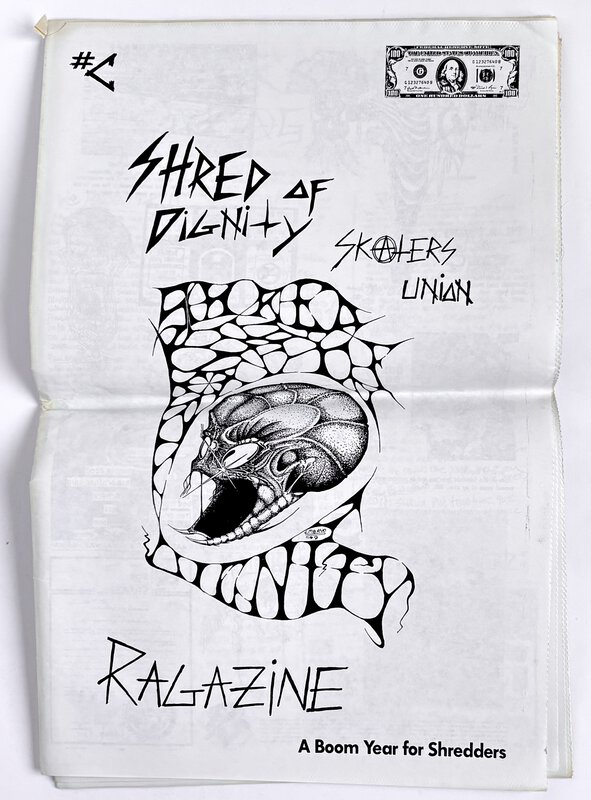
  • Radical Queer Punk Underground Skater Zine SHRED OF DIGNITY SKATERS' UNION RAGAZINE # by Tom Jennings, Editor Radical Queer Punk Underground Skater Zine SHRED OF DIGNITY SKATERS' UNION RAGAZINE #<
    Tom Jennings, Editor

    SHRED OF DIGNITY SKATERS' UNION RAGAZINE #< Tom Jennings, Editor. Published by Shred of Dignity, San Francisco, 1988. First edition. Tabloid, 17" x 11", 20 pages, illustrated in b&w throughout. VERY GOOD Condition: folded as issued, light age toning, small chip at top of spine fold, the folding is a bit off and the pages are not quite flush, otherwise, bright, clean, and unmarked. Scarce.

    Shred of Dignity Skaters' Union Ragazine was a San Francisco skateboarding queer punk zine. This jumbo issue was published in the fall of 1988 after over a year of preparation.

    The Shred of Dignity Skaters' Union was a radical pioneering San Francisco skater rights group formed in the mid 1980s to combat citywide bans on…

    (more)

    SHRED OF DIGNITY SKATERS' UNION RAGAZINE #< Tom Jennings, Editor. Published by Shred of Dignity, San Francisco, 1988. First edition. Tabloid, 17" x 11", 20 pages, illustrated in b&w throughout. VERY GOOD Condition: folded as issued, light age toning, small chip at top of spine fold, the folding is a bit off and the pages are not quite flush, otherwise, bright, clean, and unmarked. Scarce.

    Shred of Dignity Skaters' Union Ragazine was a San Francisco skateboarding queer punk zine. This jumbo issue was published in the fall of 1988 after over a year of preparation.

    The Shred of Dignity Skaters' Union was a radical pioneering San Francisco skater rights group formed in the mid 1980s to combat citywide bans on skateboarding. Arising from the skater punk and queer punk scene they united skateboarding, punk rock, DIY and social resistance. It was formed by Tom Jennings, Duke Crestfield, and Shawn Ford after City supervisors banned skateboarding on the streets of San Francisco. They overturned the bans by organizing a loose network of skaters, punks, and anarchists to defend their interests and engage in political street activism. Functioning as both a skater's rights group and a creative collective, the Shred of Dignity Skaters' Union rented a warehouse on Shipley Street in 1988, creating a "warehousehold" which served as a counterculture living, working, making and organizing space for queer punks and activists. The collective was involved in many local underground experimental scenes including 924 Gilman Street in Berkeley. Two seminal underground queer punk zines emerged from the Shred of Dignity collective, Shred of Dignity Skaters' Union Ragazine and HOMOCORE.

    (less)
    View cart More details Price: $325.00
  • Scarce LEATHER DYKE BDSM TRANSGENDER Erotica THE SECOND COMING A Leatherdyke Reader by Pat Califia and Robin Sweeney, Editors Scarce LEATHER DYKE BDSM TRANSGENDER Erotica THE SECOND COMING A Leatherdyke Reader
    Pat Califia and Robin Sweeney, Editors

    THE SECOND COMING A Leatherdyke Reader Edited by Pat Califia and Robin Sweeney, published by Alyson Publications, Los Angeles, California. 1996 First edition, so stated. Softcover, 8.5" x 5.5", 372 pages, illustrated in b&w with photographs and a drawing. NEAR FINE Condition: just a touch of light wear, overall tight, bright, clean and unmarked.

    Powerful, intimate and defiant, a landmark anthology in explicit non-conforming queer feminist literature that laid the groundwork for understanding how kink and leather communities provided a haven for people experimenting with gender performativity and body modification, well before mainstream awareness of trans identity. Cutting edge queer sadomasochistic erotica by transgender cult icon Pat Califia, a pioneering activist for sexual freedom and BDSM who later transitioned to a transgender man.

    View cart More details Price: $275.00
  • Discordian Punk Fringe Counterculture Underground Zine FALSE POSITIVE by Donna Kossy, [Editor] Discordian Punk Fringe Counterculture Underground Zine FALSE POSITIVE
    Donna Kossy, [Editor]

    FALSE POSITIVE Donna Kossy, [Editor]. Published by Out-of-Kontrol Data Korporation, San Francisco and Massachusetts, 1984-1988.

    Four original issues, of the eleven print run, of this elusive 1980s fringe culture underground zine by Discordian satirist Donna Kossy:

    #1 Technology Issue, 1984; #5 Food and Drugs Issue, 1986; #7 Generic Issue, 1987; #11 The Last Issue [Art & Ladies], 1988. Vintage first editions, side staple bound, 8.5" x 11" xeroxed sheets, each cover is an original color xerox collage by Kossy, illustrated throughout. Contributors include: Tuli Kupferberg, Hakim Bey [Peter Lamborn Wilson], Bob Black, Ace Backwords, and Pagan Kennedy. Four issues in VERY GOOD Condition: staples oxidizing but holding, issue #1 with two light horizontal creases from folding, overall bright, clean…

    (more)

    FALSE POSITIVE Donna Kossy, [Editor]. Published by Out-of-Kontrol Data Korporation, San Francisco and Massachusetts, 1984-1988.

    Four original issues, of the eleven print run, of this elusive 1980s fringe culture underground zine by Discordian satirist Donna Kossy:

    #1 Technology Issue, 1984; #5 Food and Drugs Issue, 1986; #7 Generic Issue, 1987; #11 The Last Issue [Art & Ladies], 1988. Vintage first editions, side staple bound, 8.5" x 11" xeroxed sheets, each cover is an original color xerox collage by Kossy, illustrated throughout. Contributors include: Tuli Kupferberg, Hakim Bey [Peter Lamborn Wilson], Bob Black, Ace Backwords, and Pagan Kennedy. Four issues in VERY GOOD Condition: staples oxidizing but holding, issue #1 with two light horizontal creases from folding, overall bright, clean and unmarked.

    In 1984 Donna Kossy launched False Positive (1984-1988) a self published zine that delved into obscure and unconventional ideas, establishing her interest in documenting societal outliers. She released a total of 11 issues between 1984 and 1988, each spanning 20-32 pages, blending visual experimentation with textual excerpts from unconventional sources. An archive of fringe culture filled with eccentric personalities and belief systems documenting fringe thinkers, cultural oddities, Discordian ideologies, pseudoscience, conspiracy theorists and profiling "Kooks" who espoused extreme, aberrant and discredited viewpoints. The zine employed xeroxed and stapled production methods, emphasizing the punk counterculture DIY aesthetics typical of 1980s underground publishing.

    Donna Kossy (b.1957) is an American writer, zine publisher, and independent researcher specializing in fringe science, pseudohistory, and extreme ideas dismissed by mainstream academia.

    (less)
    View cart More details Price: $475.00
  • HAIGHT ASHBURY Death Spiral REDEVELOPMENT Three Scarce Haight Ashbury Planning Studies Addressing Post Summer of Love Decline in the Early 1970s by [Urban Planning] [Counterculture] [Redevelopment] HAIGHT ASHBURY Death Spiral REDEVELOPMENT Three Scarce Haight Ashbury Planning Studies Addressing Post Summer of Love Decline in the Early 1970s
    [Urban Planning] [Counterculture] [Redevelopment]

    Three Scarce Haight Ashbury Planning Studies Addressing Post Summer of Love Decline in the Early 1970s

    In the early 1970s Haight Street was in decline and the City needed a plan. Haight Street is where the hippie movement first came to national prominence and where it first began to die. At the height of the hippie era, during the 1967 Summer of Love, the street was so crowded with flower children that driving a car through it was impossible. Stores catering to the hippies popped into existence all along "The Haight," and these were followed by other stores doing business with all the people who flocked there to see the hippies. When the hippie movement withered, it took the shops…

    (more)

    Three Scarce Haight Ashbury Planning Studies Addressing Post Summer of Love Decline in the Early 1970s

    In the early 1970s Haight Street was in decline and the City needed a plan. Haight Street is where the hippie movement first came to national prominence and where it first began to die. At the height of the hippie era, during the 1967 Summer of Love, the street was so crowded with flower children that driving a car through it was impossible. Stores catering to the hippies popped into existence all along "The Haight," and these were followed by other stores doing business with all the people who flocked there to see the hippies. When the hippie movement withered, it took the shops with it. About one-third of them were boarded up in 1973. These are the studies that influenced future planning.

    Three obscure early 1970s San Francisco Haight Ashbury urban planning/redevelopment publications:

    HAIGHT STREET SHOPPING AREA A Background Study, November, 1972 Published by the Department of City Planning, San Francisco. 1972 first edition. Illustrated brown paper covers, staple bound, 8.5" x 11", 30 pages, illustrated with maps and tables. VERY GOOD Condition: foxing/age toning to the page edges otherwise tight, bright, clean and unmarked.

    A pivotal 1972 report documenting the Haight's transition from its 1960s counterculture peak into a phase of urban decay, and the early stages of commercial revitalization. Following the summer of 1967, the Haight Ashbury experienced a period of economic decline and increased crime resulting in commercial vacancies and shifting demographics. The study was commissioned to assess local retail health and guide economic revitalization efforts along the Upper Haight corridor. The report lays the groundwork for understanding the neighborhood's eventual transformation into a gentrified retail corridor characterized by trendy boutiques and cafes.

    THE HAIGHT ASHBURY A Brief Description of the Past Published by the Department of City Planning, San Francisco. No date, circa 1971 first edition. Green paper covers, staple nouns, 8.5" x 11", 14 pages. VERY GOOD Condition: foxing/age toning to the page edges and the first page, overall tight, bright, clean and unmarked.

    Documenting the neighborhood's evolution from a windswept sand dune into a bustling Victorian streetcar suburb and its subsequent transformation into the epicenter of the 1960s counterculture movement. Originally a vast expanse of coastal sand dunes stretching to Buena Vista Park. Following the construction of the Haight Street Cable Railroad in 1883, the area boomed, resulting in the dense, impeccable Victorian architecture that survived the 1906 earthquake. The Haight became globally recognized as the birthplace of psychedelia and hippies.

    HAIGHT ASHBURY COMMUNITY SERVICES A Background Study Published by the Department of City Planning, San Francisco, March 1973. First edition. Yellow paper covers, staple bound, 8.5" x 11", 32, + 21 page appendix, illustrated with 2 maps. With laid-in introductory letter from the Director of SF Planning, Allan B. Jacobs. VERY GOOD Condition: foxing/age toning to the cover and page edges, light signs of use, overall tight, bright, clean and unmarked.

    Historic municipal report analyzing the Haight Ashbury neighborhood's socioeconomic, housing, and infrastructural needs following the cultural shifts of the late 1960s. It evaluated the area's transition into the 1970s serving as foundational research for neighborhood revitalization and zoning restrictions that aimed to stabilize the area. Examines the availability and strain on municipal resources, transit, housing, and healthcare including community led facilities like the Haight Ashbury Medical Clinics.

    (less)
    View cart More details Price: $275.00
  • EPILOGOS Signed with Original Ink Drawing by Robert Duncan EPILOGOS Signed with Original Ink Drawing
    Robert Duncan

    EPILOGOS by Robert Duncan.

    Published by Black Sparrow Press, Los Angeles, 1967. Signed limited first edition, #20 of 115 copies. Signed by Robert Duncan with an original ink drawing. Presentation copy inscribed to Duncan's close friends Ham (Hamilton) and Mary Tyler. Deep red illustrated wraps, 6.75" x 6.25", string tied, 10 numbered pages. NEAR FINE Condition: tight, bright, clean and unmarked and Duncan's drawing and signature are bold and bright.

    A major, transcendent poem by the influential American writer Robert Duncan (1919-1988) a central figure in the San Francisco Renaissance and the Black Mountain School of poetry. He was celebrated for his deeply philosophical, spiritually charged writing that blended mythology, the Western esoteric tradition, and an advocacy for LGBTQ+ civil…

    (more)

    EPILOGOS by Robert Duncan.

    Published by Black Sparrow Press, Los Angeles, 1967. Signed limited first edition, #20 of 115 copies. Signed by Robert Duncan with an original ink drawing. Presentation copy inscribed to Duncan's close friends Ham (Hamilton) and Mary Tyler. Deep red illustrated wraps, 6.75" x 6.25", string tied, 10 numbered pages. NEAR FINE Condition: tight, bright, clean and unmarked and Duncan's drawing and signature are bold and bright.

    A major, transcendent poem by the influential American writer Robert Duncan (1919-1988) a central figure in the San Francisco Renaissance and the Black Mountain School of poetry. He was celebrated for his deeply philosophical, spiritually charged writing that blended mythology, the Western esoteric tradition, and an advocacy for LGBTQ+ civil rights.

    Hamilton Tyler (1917-1983) noted scholar and author who wrote books on Pueblo Indian culture, ornithology (particularly owls), and a definitive guide to North American swallowtail butterflies. Ham was an outspoken and influential anarchist who fought with the Republicans in the Spanish Civil War. Ham and Mary befriended many writers and were long time friends of Robert Duncan. Mary was an accomplished poet and was at one point married to the poet William Everson.

    (less)
    View cart More details Price: $300.00
  • SOLSTICE BLOSSOM with Original Watercolor by Michael McClure SOLSTICE BLOSSOM with Original Watercolor
    Michael McClure

    SOLSTICE BLOSSOM by Michael McClure

    Published by Arif Press, [Berkeley, CA] , Winter Solstice 1973. First edition. Illustrated wraps, string binding, 11" x 9", 22 pages. NEAR FINE Condition. Cover photograph by Constance Baxter. Number 5 of 30 copies with an ORIGINAL WATERCOLOR by Wesley Tanner and SIGNED by McClure and Tanner.

    View cart More details Price: $300.00
  • THE BLACK BOOK 1992-1993 San Francisco LGBTQ+ Queer Leather Alternative Sexual Directory 1st Issue by Bill Brent THE BLACK BOOK 1992-1993 San Francisco LGBTQ+ Queer Leather Alternative Sexual Directory 1st Issue
    Bill Brent

    THE BLACK BOOK 1992-1993

    Published by Bill Brent, San Francisco, first edition, 1992. Softcover, plastic comb binding, 200 unnumbered pages, illustrated in b&w throughout. Very Good Condition: wear to the covers, otherwise tight, bright, clean and unmarked. Uncommon.

    Rare first issue of this alternative directory for San Francisco's Leather community.

    Bill Brent was involved in the Bay Area bisexual, BDSM, Black Leather, radical faerie, and pro sex literary communities in the 1990s. He published The Black Book which is one of the first queer and alternative sexuality directories. A prolific author of sex-positive literature and a member of San Francisco's alternative sexuality communities, he died during the weekend of August 18-19 by jumping off the Golden Gate Bridge after a…

    (more)

    THE BLACK BOOK 1992-1993

    Published by Bill Brent, San Francisco, first edition, 1992. Softcover, plastic comb binding, 200 unnumbered pages, illustrated in b&w throughout. Very Good Condition: wear to the covers, otherwise tight, bright, clean and unmarked. Uncommon.

    Rare first issue of this alternative directory for San Francisco's Leather community.

    Bill Brent was involved in the Bay Area bisexual, BDSM, Black Leather, radical faerie, and pro sex literary communities in the 1990s. He published The Black Book which is one of the first queer and alternative sexuality directories. A prolific author of sex-positive literature and a member of San Francisco's alternative sexuality communities, he died during the weekend of August 18-19 by jumping off the Golden Gate Bridge after a long struggle with depression and chronic pain. He was 52.

    (less)
    View cart More details Price: $225.00
  • RICK GRIFFIN HAND SIGNED and INSCRIBED POSTER ART BOOK by Rick Griffin RICK GRIFFIN HAND SIGNED and INSCRIBED POSTER ART BOOK
    Rick Griffin

    SIGNED and INSCRIBED by RICK GRIFFIN "To Bruce Bard In Friendship." Signed in thick black pen in his cross like trademark style.

    Rick Griffin. Published by Perigee Paper Tiger (G.P. Putnam's Sons), New York City, 1980. Stated First Printing. Photographs by Bob Seidemann. Publisher's illustrated glossy card wraps, perfect bound, 11.25" x 8.25", 95 pages. Fully illustrated in color by Griffin showcasing his legendary psychedelic posters, surf posters, underground comix, album covers, and more. Very Good Condition: light shelf wear and edgewear to the covers but the spine remains uncreased. Internally, a touch of age, overall tight, bright, clean and unmarked. Rare Signed.

    Rick Griffin (1944 -1991) American artist. One of the legendary 'Big Five' psychedelic poster artists of the…

    (more)

    SIGNED and INSCRIBED by RICK GRIFFIN "To Bruce Bard In Friendship." Signed in thick black pen in his cross like trademark style.

    Rick Griffin. Published by Perigee Paper Tiger (G.P. Putnam's Sons), New York City, 1980. Stated First Printing. Photographs by Bob Seidemann. Publisher's illustrated glossy card wraps, perfect bound, 11.25" x 8.25", 95 pages. Fully illustrated in color by Griffin showcasing his legendary psychedelic posters, surf posters, underground comix, album covers, and more. Very Good Condition: light shelf wear and edgewear to the covers but the spine remains uncreased. Internally, a touch of age, overall tight, bright, clean and unmarked. Rare Signed.

    Rick Griffin (1944 -1991) American artist. One of the legendary 'Big Five' psychedelic poster artists of the 1960s. His work appeared on many iconic San Francisco rock concert posters and Grateful Dead album covers. As a contributor to the underground comix movement, his work appeared regularly in Zap Comix. In the mid-1960s, he participated in Ken Kesey's Acid Tests. His first art exhibition was for the Jook Savages, celebrating the one-year anniversary of the Psychedelic Shop on Haight Street. As a boy, Griffin was influenced by Native American culture, comic books, and surf culture.

    Bruce Bard was a Petaluma philanthropist, music lover, Deadhead, and old hippie.

    (less)
    View cart More details Price: $1,200.00
  • BEATITUDE #8 Bob Kaufman Jail Poems, + Ginsberg, Meltzer, Weiss, Ferlinghetti, et al BREAD & WINE MISSION S.F. 1959 by Bob Kaufman, Allen Ginsberg, David Meltzer, Ruth Weiss, et al BEATITUDE #8 Bob Kaufman Jail Poems, + Ginsberg, Meltzer, Weiss, Ferlinghetti, et al BREAD & WINE MISSION S.F. 1959
    Bob Kaufman, Allen Ginsberg, David Meltzer, Ruth Weiss, et al

    BEATITUDE #8 Bob Kaufman Jail Poems, + Ginsberg, Meltzer, Weiss, Ferlinghetti, et al BREAD & WINE MISSION S.F. 1959

    BEATITUDE #8. Published by the BREAD & WINE MISSION, San Francisco, 1959. Includes Jail Poems by Bob Kaufman and poetry by many others.

    Twenty four (24) mimeographed leaves printed on one side only, including the cover sheet which is blue, 8.5x11 inches, side stapled.

    Beatitude was printed at the Bread & Wine Mission in San Francisco, a hub of counterculture and beat poetry. Printed on simple mimeograph machines by the poets themselves, few copies of the early issues remain.

    GOOD condition: The front cover printed face and stars of this copy have been shaded in with pencil - perhaps before being…

    (more)

    BEATITUDE #8 Bob Kaufman Jail Poems, + Ginsberg, Meltzer, Weiss, Ferlinghetti, et al BREAD & WINE MISSION S.F. 1959

    BEATITUDE #8. Published by the BREAD & WINE MISSION, San Francisco, 1959. Includes Jail Poems by Bob Kaufman and poetry by many others.

    Twenty four (24) mimeographed leaves printed on one side only, including the cover sheet which is blue, 8.5x11 inches, side stapled.

    Beatitude was printed at the Bread & Wine Mission in San Francisco, a hub of counterculture and beat poetry. Printed on simple mimeograph machines by the poets themselves, few copies of the early issues remain.

    GOOD condition: The front cover printed face and stars of this copy have been shaded in with pencil - perhaps before being distributed (this was printed by the crazy Beats, after all), perhaps by the owner - giving the printed face the nice look of a person of color. There is an R written at the top left corner of the front cover. The pages have some toning, there is a variation in the intensity of the mimeo printing, and the mimeo process has left some smudges; one poem has a couple margin marks noting a passage and "Plato's allegory?" written in the margin beside the passage; overall a complete, solid, nice copy.

    SCARCE BEATITUDE printed in 1959 at the BREAD & WINE MISSION in San Francisco.

    From the first page:

    ******In the snakepit of our city jail, with a man next to him dying unattended and himself sick from having been stamped upon by a public SERVANT, Kaufman writes his poems of suffering and compassionate identification. Their immediacy characterizes much of the poetry here printed. Margolis adds his poem of protest. The two poems are "confiscated" from the window of the bagel shop by officer 67. Ed Freeman, descending on the beach [North Beach, San Francisco] for a week. makes some great scenes performing his poems and adds his sympathy to both the black and the blue. Ginsberg sends a telegram but his poem on sakyamuni counsels more. Beatitude changes offices, we run through three bad mimeo machines, finally get a good one. At last, with many poems we find beautiful to print and a good percentage of the poets out of jail, we resume our publication at the bread and wine mission, corner greenwich and grant or at various outlets on the beach.******

    About the BREAD & WINE MISSION (From a 2021 Issue of Outside Lands - Journal of San Francisco History):

    ******Despite the place's obscurity today, the Bread and Wine Mission played a substantial role in the Beat scene by providing a space where poets, artists and intellectuals could commune and make their ideas manifest. [The article includes a photo with the caption: William Margolis, Eileen Kaufman, and Bob Kaufman printing Beatitude at the Bread and Wine Mission, April 1959.]******

    (less)
    View cart More details Price: $400.00
  • TAYLOR OF SAN FRANCISCO Rare 1978 LEATHERMEN Gay BDSM Kink Gear SHOP LITHOGRAPH by [Poster] [LGBTQ+] TAYLOR OF SAN FRANCISCO Rare 1978 LEATHERMEN Gay BDSM Kink Gear SHOP LITHOGRAPH
    [Poster] [LGBTQ+]

    TAYLOR OF SAN FRANCISCO Custom Leather, Body Jewelry Free Piercing, 3-Star Aroma, Leather Repairs, Hot Action Art, Toys For The Playroom [At The Brig]

    Original 1978 Illustrated Advertising Poster. (I can't find information on the artist). B&W lithograph on heavy paper, 21" x 14.25". VERY GOOD CONDITION: stiff creases, some age toning to the rear, a handsome piece of San Francisco LGBTQ+ ephemera.

    Way before the Folsom Street Fair, Leathermen paraded along the streets of SoMa, mostly after dark. Decked out in black or western leather chaps, vests, jackets, belts, harnesses, and codpieces, all that rigging, kink wear, BDSM restraints and body jewelry were made and sold in the fantasy leather and sex toy shops found in SoMa bars like…

    (more)

    TAYLOR OF SAN FRANCISCO Custom Leather, Body Jewelry Free Piercing, 3-Star Aroma, Leather Repairs, Hot Action Art, Toys For The Playroom [At The Brig]

    Original 1978 Illustrated Advertising Poster. (I can't find information on the artist). B&W lithograph on heavy paper, 21" x 14.25". VERY GOOD CONDITION: stiff creases, some age toning to the rear, a handsome piece of San Francisco LGBTQ+ ephemera.

    Way before the Folsom Street Fair, Leathermen paraded along the streets of SoMa, mostly after dark. Decked out in black or western leather chaps, vests, jackets, belts, harnesses, and codpieces, all that rigging, kink wear, BDSM restraints and body jewelry were made and sold in the fantasy leather and sex toy shops found in SoMa bars like Taylor of San Francisco at the Brig. South of Market was one of the most extensive and densely occupied Leather neighborhoods in the world.

    Joe Taylor ran his leather goods shop at the back of Brig Bar in 1978 and moved to the Ramrod Bar circa 1982. He also ran a custom leather workshop and private dungeon (featured in the "Dungeons of San Francisco" issue of Drummer magazine, #17) on Clementina in SoMa from the late 70s into the mid 80s. In the style of the times, Taylor billed his business as "Taylor of San Francisco" following the gay icon "Tom of Finland." Taylor was a SoMa icon in his own right and his workshop is listed in the SoMa registry of historic places.

    (less)
    View cart More details Price: $545.00
  • Cancelled BLACK Jazz Age Novel NYC GANG CULTURE Harlem Renaissance 1ST Edition in Scarce Dustjacket THE PRINCE OF WASHINGTON SQUARE by Harry F. Liscomb Cancelled BLACK Jazz Age Novel NYC GANG CULTURE Harlem Renaissance 1ST Edition in Scarce Dustjacket THE PRINCE OF WASHINGTON SQUARE
    Harry F. Liscomb

    The Prince of Washington Square An Up-To-The Minute Story By Harry F. Liscomb

    Published by Frederick A. Stokes Company, New York, 1925. First edition. Hardcover in original orange dustjacket. Hardcover, illustrated orange paper covered boards, hint of grey topstain, 7.5" x 5.25", 180 pages, in its un-priceclipped dustjacket. GOOD CONDITION: the covers have a few small droplet stains, toning and wear to the edges but remains solid and bright, internally very good, some areas of small staining, overall tight, bright, clean and unmarked. In a fair dj with droplet staining, toning to the spine and folds, chipping to the fold and spine-ends, and some small scrapes, overall solid, legible and the flaps remain quite bright!

    One of the first Black…

    (more)

    The Prince of Washington Square An Up-To-The Minute Story By Harry F. Liscomb

    Published by Frederick A. Stokes Company, New York, 1925. First edition. Hardcover in original orange dustjacket. Hardcover, illustrated orange paper covered boards, hint of grey topstain, 7.5" x 5.25", 180 pages, in its un-priceclipped dustjacket. GOOD CONDITION: the covers have a few small droplet stains, toning and wear to the edges but remains solid and bright, internally very good, some areas of small staining, overall tight, bright, clean and unmarked. In a fair dj with droplet staining, toning to the spine and folds, chipping to the fold and spine-ends, and some small scrapes, overall solid, legible and the flaps remain quite bright!

    One of the first Black authored novels of the 1920s, it was published by a major white New York publisher and was very popular and aggressively advertised especially in the Black media. Suddenly it was totally ignored by the white press after being destroyed by a white critic in the Saturday Review of Literature [May 23, 1925]. Set in Greenwich Village, focusing on multiethnic youth gang culture and contemporary Blackness. Written when the author was just 19 years old, he was planning another novel but that never happened. A lifelong New Yorker, Harry F. Liscomb (b. Circa 1906) died in obscurity probably in Queens.

    For informational purposes, the last three photos are images of 1925 newspaper reviews of Liscomb's novel: review with photograph of the author, from the The Afro-American, South's Biggest and Best Weekly; The Saturday Review of Literature (May 23, 1925) white media takedown of the book; The Negro World April 18, 1925, Newspaper devoted solely to the interests of the Negro race. (These clippings are not included).

    (less)
    View cart More details Price: $345.00
  • CHARLES BUKOWSKI Graphic Novel MATTHIAS SCHULTHEISS Illustrations SERBIAN TEXT by Charles Bukowski, Matthias Schultheiss CHARLES BUKOWSKI Graphic Novel MATTHIAS SCHULTHEISS Illustrations SERBIAN TEXT
    Charles Bukowski, Matthias Schultheiss

    ZABELESKE MATOROG POKVARENJAKA, by Carls Bukovski (Charles Bukowski), illustrated by Matijas Sultajs (Matthias Schultheiss).

    A GRAPHIC RENDITION of several works by CHARLES BUKOWSKI as IMAGINED & ILLUSTRATED by MATTHIAS SCULTHEISS. Based on Bukowski's NOTES OF A DIRTY OLD MAN, TALES OF ORDINARY MADNESS, and SOUTH OF NO NORTH.

    This is the SERBIAN EDITION of the graphic novel that was originally published in GERMANY. TEXT in SERBIAN.

    Hardcovers, 8.5x12 inches, 145 pages.

    Published by Makondon, Belgrade, 2014. Republished in softcover in 2016. The hardcover edition is especially difficult to find.

    NEAR FINE condition, a touch of wear to the spine ends, overall looks and feels unread, tight, bright, clean, and unmarked.

    Bukowski's bad influence has spread throughout the world! Hooray!

    View cart More details Price: $45.00
  • OBSOLETE! Counterculture Punk Tabloid from Iowa 5 VINTAGE ISSUES including the PREMIER ISSUE 2010-2014 by Rich Dana, editor OBSOLETE! Counterculture Punk Tabloid from Iowa 5 VINTAGE ISSUES including the PREMIER ISSUE 2010-2014
    Rich Dana, editor

    OBSOLETE! Five Vintage Issues of this counterculture punk tabloid: Issue #1 (the Premier Issue), Issue #3, Issue #5, Issue #7, and Issue #8. Published by Obsolete! Press, Victor, Iowa, 2010-2014.

    From the Premier Issue: "Obsolete! Magazine is a quarterly tabloid publication in the tradition of...The East Village Other, The Berkeley Barb, The Chicago Seed, PUNK!, and other great underground rags of days past..." The issues were edited by Rich Dana.

    Five newspaper style tabloids, printed on newsprint, 16-23 pages each.

    GOOD condition, lightly used, lightly age toned, still solid, clean and clear.

    Counterculture, Underground Punk from Victor, Iowa. Who knew?

    View cart More details Price: $115.00
  • Jim Jones PEOPLES TEMPLE 1977 Peoples Forum Newspaper CULT Huey Newton BLACK PANTHERS by [Counterculture] [Cults] Jim Jones Jim Jones PEOPLES TEMPLE 1977 Peoples Forum Newspaper CULT Huey Newton BLACK PANTHERS
    [Counterculture] [Cults] Jim Jones

    Peoples Forum, Vol. I, No. 17, March 1, 1977. Published by Peoples Temple of the Disciples of Christ, San Francisco, CA. First edition, broadsheet format, one folded sheet, four pages printed on newsprint. GOOD CONDITION: tender at the folds with tiny chips/wear, some edge tears/wear, and light age toning, otherwise bright and clean. Scarce.

    In April 1976, Jim Jones' Peoples Temple launched Peoples Forum. Distributed on the street by Temple volunteers and dropped on doorsteps throughout San Francisco, it served as the Temple's monthly newspaper and main source of promotion and communication. The header shows three faces of different races, civil rights related imagery Jones used to advertise his interracial religious movement.

    Jones' increasing radicalism and connection to the civil…

    (more)

    Peoples Forum, Vol. I, No. 17, March 1, 1977. Published by Peoples Temple of the Disciples of Christ, San Francisco, CA. First edition, broadsheet format, one folded sheet, four pages printed on newsprint. GOOD CONDITION: tender at the folds with tiny chips/wear, some edge tears/wear, and light age toning, otherwise bright and clean. Scarce.

    In April 1976, Jim Jones' Peoples Temple launched Peoples Forum. Distributed on the street by Temple volunteers and dropped on doorsteps throughout San Francisco, it served as the Temple's monthly newspaper and main source of promotion and communication. The header shows three faces of different races, civil rights related imagery Jones used to advertise his interracial religious movement.

    Jones' increasing radicalism and connection to the civil rights movement became apparent with the Peoples Forum. While early issues contain articles on "subjects as diverse as killer bees, Muhammed Ali, freedom of the press, and Jones hosting a TV show," later editions are more radical, illustrating Jones' support for Huey Newton and the Black Panther Party. In late 1976 Peoples Forum covered a story about the FBI's role in the death of Black Panther Party leader Fred Hampton. The cover photo from this March 1, 1977 edition shows Jones and Newton shaking hands. Peoples Forum exemplifies the increasing involvement Peoples Temple had in California with Black rights leaders, racial issues, and activism. Additionally, Peoples Forum denounced and exposed the rising dangers of neo Nazism in San Francisco.

    Jim Jones' Peoples Temple is notorious for the way it ended in on November 18, 1978 with more than 900 people dying in a mass murder suicide at the Peoples Temple Settlement in Jonestown, Guyana. The majority of the Jonestown massacre victims were black women.

    (less)
    View cart More details Price: $695.00
  • BRAZILIAN GRAFFITI STREET ARTIST ALEXANDRE ORION - METABIOTICA **SIGNED** 2006 by ALEXANDRE ORION BRAZILIAN GRAFFITI STREET ARTIST ALEXANDRE ORION - METABIOTICA **SIGNED** 2006
    ALEXANDRE ORION

    METABIOTICA / METABIOTICS. Monograph on the Brazilian Graphic Street Artist ALEXANDRE ORION.

    SIGNED and DATED by ORION on the back cover.

    Printed in Sao Paolo, Brazil, by EGM Grafica, 2006. Polyglot edition, text in Portuguese, English, French and Spanish. ISBN 10: 8598614033 ISBN 13: 978-8598614038.

    Softcover book in printed slipcase, 12x12 inches (30x30 cm), 80 pages. Fully illustrated throughout.

    Condition: NEAR FINE book, tight, bright, clean and unmarked; in a VERY GOOD slipcase that has a touch of wear at its folds. A lovely copy.

    RARE, especially so SIGNED.

    About ALEXANDRE ORION (from Wikipedia):

    ******Alexandre Orion, b.1978 in Sao Paulo, is a Brazilian street artist, multimedia artist and muralist.

    He started as a graffiti artist in 1992, soon expanding into…

    (more)

    METABIOTICA / METABIOTICS. Monograph on the Brazilian Graphic Street Artist ALEXANDRE ORION.

    SIGNED and DATED by ORION on the back cover.

    Printed in Sao Paolo, Brazil, by EGM Grafica, 2006. Polyglot edition, text in Portuguese, English, French and Spanish. ISBN 10: 8598614033 ISBN 13: 978-8598614038.

    Softcover book in printed slipcase, 12x12 inches (30x30 cm), 80 pages. Fully illustrated throughout.

    Condition: NEAR FINE book, tight, bright, clean and unmarked; in a VERY GOOD slipcase that has a touch of wear at its folds. A lovely copy.

    RARE, especially so SIGNED.

    About ALEXANDRE ORION (from Wikipedia):

    ******Alexandre Orion, b.1978 in Sao Paulo, is a Brazilian street artist, multimedia artist and muralist.

    He started as a graffiti artist in 1992, soon expanding into murals, photography and multimedia. Orion has held a number of solo exhibitions internationally and his work has been exhibited or acquired by such venues as the Centro Cultural Banco do Brasil, Centro Cultural da Caixa, Pinacoteca do Estado de São Paulo, Fondation Cartier Pour l'Art Contemporain in Paris, Centrum Beeldende Kunst of Rotterdam, Milwaukee Museum, Nelson-Atkins Museum of Art, Spencer Museum of Art, and the Museum of Arts and Design in New York.******

    (less)
    View cart More details Price: $150.00
  • BEAT POETRY Rarity LEW WELCH 1965 BROADSIDE Words & Music SUPERMARKET "Everything Is Wrapped In Plastic" by Lew Welch [Beat Poetry] [Broadside] BEAT POETRY Rarity LEW WELCH 1965 BROADSIDE Words & Music SUPERMARKET "Everything Is Wrapped In Plastic"
    Lew Welch [Beat Poetry] [Broadside]

    SUPERMARKET Words and Music By LEW WELCH and CHRIS ROBERTS

    BROADSIDE, self published 1965, 13" x 9.75", reproduced holograph manuscript music score and chord chart for spoken word, voice and orchestra, printed on thin brown paper.

    NEAR FINE CONDITION. This copy is from the personal collection of Donald Allen. Scarce, only one copy held in institutional hands located in the Lew Welch Papers at Special Collections & Archives UC San Diego, which was originally acquired from Donald Allen.

    LEW WELCH (1926-1971) prominent Beat and cult figure, one of a handful of poets including Allen Ginsberg, Gary Snyder and Michael McClure, who emerged from the San Francisco Renaissance of the 1950s. Welch was a misfit even among the Beats. He wrote…

    (more)

    SUPERMARKET Words and Music By LEW WELCH and CHRIS ROBERTS

    BROADSIDE, self published 1965, 13" x 9.75", reproduced holograph manuscript music score and chord chart for spoken word, voice and orchestra, printed on thin brown paper.

    NEAR FINE CONDITION. This copy is from the personal collection of Donald Allen. Scarce, only one copy held in institutional hands located in the Lew Welch Papers at Special Collections & Archives UC San Diego, which was originally acquired from Donald Allen.

    LEW WELCH (1926-1971) prominent Beat and cult figure, one of a handful of poets including Allen Ginsberg, Gary Snyder and Michael McClure, who emerged from the San Francisco Renaissance of the 1950s. Welch was a misfit even among the Beats. He wrote for the hipsters, Beats and beatniks who gathered nightly in San Francisco to listen to jazz, drink cappuccinos and sip red wine. In 1971 he wrote a suicide note that read, "I never could make anything work out right and now I'm betraying my friends." Then, with gun in hand he wandered into the forest surrounding Gary Snyder's home in the Sierra Nevadas, his body has never been found.

    DONALD ALLEN (1912-2004) Lew Welch's literary executor, Grove Press editor, publisher, and author of The New American Poetry 1945-1960, the landmark literary anthology that has come to define the canon of early Beat poetry.

    (less)
    View cart More details Price: $1,225.00